
Equipped for the Kingdom: Stewarding the Church’s Confession
Mary Asta Mountain | March 11, 2025

Andrew Mark Adil has asked questions his whole life. By God’s grace, these questions paved the road that led him from his Muslim faith, over the hills of agnosticism, through a blossoming understanding and belief in the gospel, and into the hard but beautiful work of ministry. Now, Andrew Mark serves as a Reformed Baptist church planter in Montreal, Quebec, where he seeks to reach a population deeply averse to Christianity and the truth of the gospel.
Even as a pastor actively involved in ministry and equipped with multiple degrees, Andrew Mark still had questions. It was this search for answers that ultimately led him to Southeastern to pursue a Doctor of Ministry.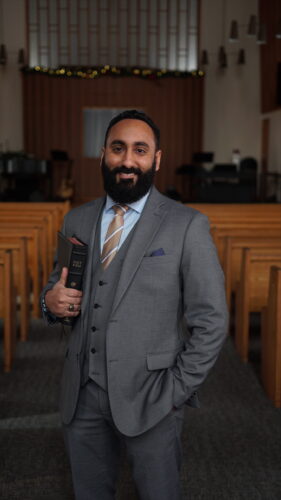
“How does reformed theology contribute to church planting, if at all?” Andrew Mark wanted to know. Then he began considering confessional theology, which prompted him to ask, “Is this in Scripture? Is it biblical?”
Even if he answered these questions, he still faced the challenge of applying the answers in his ministry context. What would it look like to train and equip fellow church planters to lead their congregations in the word of God with both theological and methodological consistency?
Moreover, what did it look like to do this in a difficult place?
Defending the Truth of the Gospel
Originally born in Saudi Arabia, Andrew Mark and his family immigrated to Canada during his teenage years. While in university and over the course of his years in ministry, he grew familiar with the country’s cultural stance towards Christianity.
“Quebec is less than 1% evangelical,” Andrew Mark said, “and Canda is 5% evangelical — so it’s a very difficult place, Quebec especially.”
As he described, Quebec is historically “a Roman Catholic Stronghold,” but in the past 60-70 years the population has overwhelmingly rejected Christianity. However, this doesn’t mean that God isn’t at work. In fact, Andrew Mark has grown convinced that “creedal, confessional Christianity, resting on the foundations of the Scriptures, is a bulwark,” defending the truth of the gospel in places like Quebec.
It was during his time at Southeastern Seminary that Andrew Mark grew in this confidence as he challenged and cemented both his theology and methodology in the authoritative, inerrant word of God.
Cementing a Foundation in Seminary
When Andrew Mark started his first DMin classes at Southeastern, he was passionate about his subject and the application that it could have for the body of Christ. However, as with any scholar at the outset of a long project, many of his ideas lacked clear direction or formation.
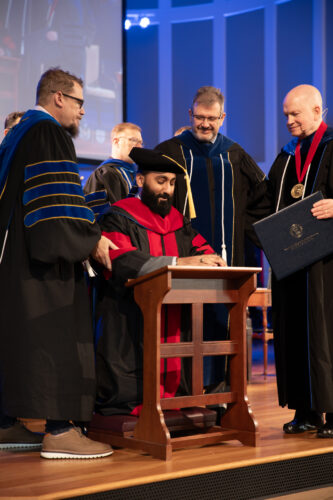 Should he encompass a wider context in his solution? Could he apply his research more globally? What direction should his research ultimately take?
Andrew Mark’s professors proved invaluable guides, directing and challenging him as he worked through the process of formulating his thoughts. In the classes leading up to his final project, they helped him narrow his focus to his personal context and directed him towards the most crucial elements of his argument.
The church Andrew Mark had planted was already operating as a Reformed Baptist church, following many of the practices he was currently studying, such as liturgical worship services and the use of creeds and confessions. While working on his DMin, his goal wasn’t to learn a new way of doing things but rather to determine whether or not his theology and methodology aligned with Scripture — and if they did, then to discover how to implement them in future church plants, especially those in difficult places.
“Digging into the biblical evidence and doing the exegetical work — that was a really big highlight for me,” Andrew Mark recalled. “It really cemented the foundation for confessionalism and confirmed that it is biblical.”
Digging into the biblical evidence and doing the exegetical work — that was a really big highlight for me. It really cemented the foundation for confessionalism and confirmed that it is biblical.
As he entered the writing stage of his project, Andrew Mark asked Dwayne Milioni, associate professor of preaching at Southeastern, to act as his project chair. Milioni and professors like Matt Rogers, assistant professor of North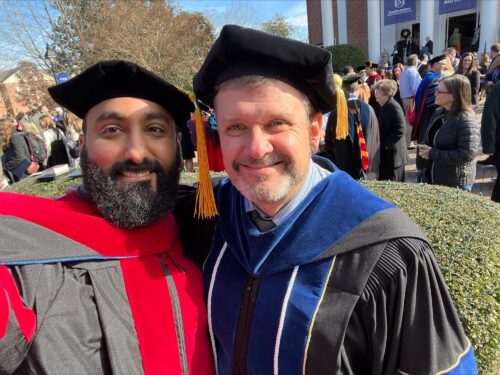 American church planting, had played a pivotal role in Andrew Mark’s decision to study at Southeastern.
“I wanted to write about church planting,” he said, and as such, “I wanted to be with these guys who have been doing that work, who are scholars in their own right, and who are church planters and practitioners. That was really attractive for me.”
Throughout Andrew Mark’s months of writing and research, Milioni invested in him and his work, challenging him to return continually to the Scriptures, to search more deeply, and to add more textual proof than he thought he needed, sinking the supports of his argument fully in God’s word.
When it came time to present his project, Andrew Mark asked Rogers to sit on his evaluation panel alongside two other men, the director of the North American Mission Board of Canada and a Southeastern graduate who served as a church planting catalyst in Montreal. Both men, like Milioni and Rogers, had significantly impacted Andrew Mark and his decision to come to Southeastern.
As such, the panel he stood before represented not only experts in his field but also the faithfulness of God in Andrew Mark’s life, bringing him to that moment as a soon-to-be Southeastern DMin graduate.
Witnesses of the Truth
While serving in Montreal, Andrew Mark began to observe how God had been preparing him for ministry in hard places prior even to his conversion to Christianity.
His Muslim and agnostic background motivated him to seek answers thoroughly and to value the history of Christianity. Most of all, his search for truth led him to the supremacy of God’s word and its authority in all areas of life. It was this journey to find the true God that would later give him context for understanding reaching the 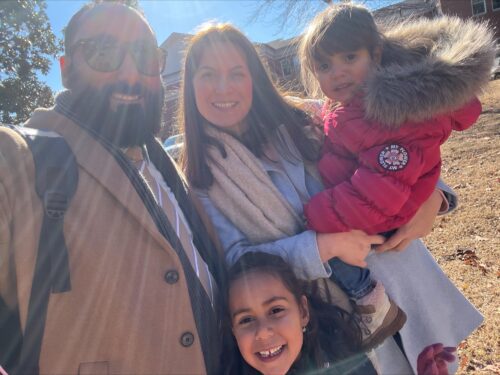 lost in his own city.
Andrew Mark has observed a similar search for faith amongst his fellow Quebecers. Because of their country’s rejection of modern Christianity, these seekers tend to express interest in the history of the Christian faith, wanting to understand what Christians have always believed over thousands of years. It is the tendency, Andrew Mark has noticed, that makes Eastern Orthodoxy so attractive to many Quebec residents, with its rituals and high deference to historical tradition.
In contrast, what Andrew Mark’s church body offers — and what he hopes to create in other Baptist church plants — is a respect for Christian tradition and history that ultimately submits to the authority and truth of Scripture. Confessionalism, he has seen, is able to serve “as guardrails to defend Christian orthodoxy.”
“My DMin project cemented the biblical, theological foundation of what we’re doing as a church — the what, why, and how of our church,” Andrew Mark expressed. His studies challenged him to ask himself and others, “Are you theologically and methodologically consistent?”
My DMin project cemented the biblical, theological foundation of what we’re doing as a church — the what, why, and how of our church.
Challenging students like Andrew Mark to integrate theology into the everyday life of their church, Southeastern prepares men and women to meet opposition to the faith with the truth of Scripture. God has used this readiness to speak and practice truth to flourish Andrew Mark’s ministry in a difficult place. God has also proven himself faithful to provide for, instruct, and guide Andrew Mark as he seeks to lead his church faithfully in submission to the word of God, allowing it to instruct every aspect of life.
“Pray that the Lord brings more people to know him,” Andrew Mark asks, “and that we would be good witnesses, not just by our behavior but also our theology and its consistency with Scripture.”
Join us in lifting up Andrew Mark, his church, and the work of other church plants as they seek to spread the gospel throughout Canada, sharing the good news of King Jesus. Pray that God would grant them peace and protection in their labors and that the fruit of their harvest would be bountiful.