At the Office with Dr. Moseley
Mary Asta Mountain | June 19, 2025

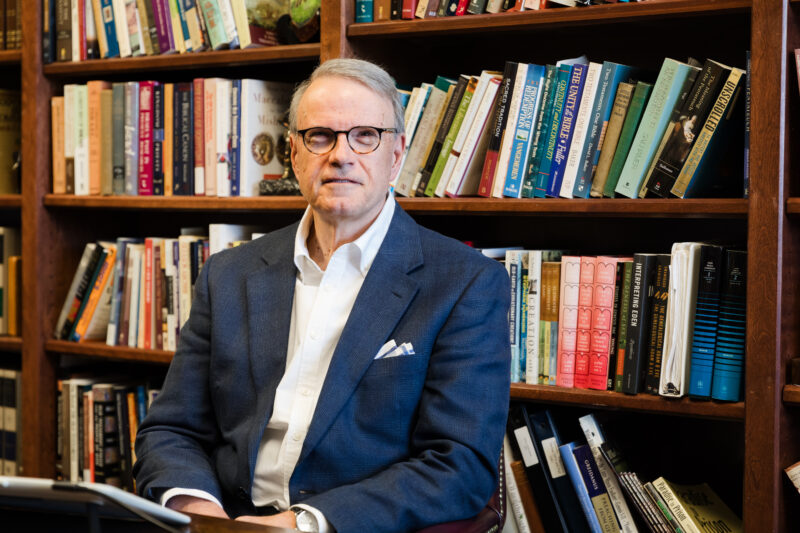
Dr. Allan Moseley has taught at Southeastern Seminary for the past 29 years. As senior professor of Old Testament and Hebrew, he is passionate about cultivating in his students a love for God as they grow in their understanding of his word. In the following Q&A, Moseley takes some time to share about his life, how God called him to the work of ministry, why he decided to teach, and what he’s learned over the years.
How did God save you?
My parents were Christians, and they took my sister and me to church; that’s how I heard the gospel. We had a pastor who preached about putting our faith in Christ, not only as Savior but also as Lord. So, I understood that if I received Christ as my Savior, he would be my Lord, and therefore I would be giving control of my life to him. And I did not want to do that. So, I resisted, until finally the conviction of the Holy Spirit brought me to the point of yielding my life to Christ as a teenager. I was 13 years old, and everything about my life changed at that point.
How did God call you to ministry?
It happened the summer before my senior year in high school; I could take you to the spot where I sensed the Lord speak to me and tell me that my future was serving him vocationally. And of course, I thought, “That was a powerful spiritual experience. But maybe it was just emotional. Maybe it was just my idea, not God.” So I said, “I’m not going to tell anybody about that. I’m just going to pray about it a long time.” And I did, for seven months. I prayed and continued to seek the Lord and ask, “Is this your will?” And finally I decided, “I know beyond a shadow of a doubt, that’s what God’s called me to do.” I didn’t know vocationally what that would be, but I knew I was going to pursue ministry, so I stepped out in that direction.
And finally I decided, “I know beyond a shadow of a doubt, that’s what God’s called me to do.”
How did you meet your wife, Sharon?
She doesn’t remember the first time we met. But then, to be honest, we weren’t really meeting each other; others were present. Later, though, we were in choir in college together, and I sang behind her. Then we started talking with one another and then getting together to study, and we became friends. We prayed together, studied together, talked, and then our hanging out changed into dating at some point. We got married in December of 1979, 45 years ago.
What originally led you to pursue Old Testament and Hebrew as your studies?
In college I had an Old Testament intro course with a professor who was profoundly liberal and denied the truth of the Old Testament miracles and some of its history, and that was a major challenge to my faith. I was only 18 years old, and it really blew me out of the water. I’ve often wondered if maybe that was part of my decision to pursue Old Testament, and Hebrew too, so that I could be a professor of Old Testament and Hebrew and also believe the Bible, being an inerrantist. That way I could give students the kind of experience that I did not have when I first studied the Old Testament.
Which Old Testament book is the most challenging to teach, and which have you found the most encouraging?
I think, for me, Isaiah is the most challenging because it’s so large. In terms of breadth, its 66 chapters address Isaiah’s lifetime all the way to the consummation of the age — the prophecies go that far. As for depth, to consider all the messianic prophecies and what they mean — there’s a lot to talk about.
The most encouraging book is probably Proverbs. I love the practicality of Proverbs, and I wrote a book on it. The more I’ve studied Proverbs, the more I see connections to the rest of the Old Testament. For example, Yahweh is mentioned numerous times, and we’re told to trust in him. The fear of the Lord is also prominent. These are important ideas in Old Testament theology, so it is not only very related to everyday life but also related to faith in the Lord.
How do you want your students to grow in their understanding and love of God as they spend more time in the Old Testament texts?
I think a lot of students, and a lot of Christians, have sort of a truncated view of God. I’d like them to see that, yes, God is gracious and merciful, but he is also holy and hates sin. And yes, we are to love him and feel close to him, but also we are to fear him, worship him, and stand in awe of him. I hope that they would see that there’s more to God than we can put in a box and that they would begin to see his mystery and inscrutability — that God is bigger than they might have thought. When we walk through the Old Testament, book by book, I’d like for them to encounter ideas about God and about the structure of the universe that cause their thinking about God to expand and deepen.
I hope that they would see that there’s more to God than we can put in a box and that they would begin to see his mystery and inscrutability — that God is bigger than they might have thought.
What projects are you currently working on?
I’ve got two projects that I’m working on writing. One is an Old Testament theology book that I would like to call “God’s Call to Life with Him.” That’s a major project, and I’ve got a lot of pages written, but it’s a long way from being publishable. The second is more attainable. It’s a book on suffering as it is reflected in the Old Testament. The topic of suffering has always interested me, and collecting books on suffering has been a hobby of mine through the decades. It’s something I personally have struggled with, preached on, thought about, and I would like to help others by writing on that.
What do you and your family like to do in your free time?
I like to fish, and I like to read. I’m a bass fisherman, but I’m not a purist. I just like to catch fish. I bought a boat last year, so I try to go more. I would also say one of my hobbies is getting together with my family. We like to get together, and we talk and eat. My wife and I love to play with the grandkids (nine of them), and we just play anything — throwing a ball, board games, you name it. We like doing anything with them. We try to take our grandkids somewhere special on their birthdays too, just to go out to eat, go to a movie, or something like that.
How has your experience as a pastor impacted the way that you teach and vice versa? How do you see these roles relate to each other?
First, I think my teaching and my academic work have made me a more careful preacher, impressing on me that what I say in the pulpit has to be right; it has to be well informed, and my exegesis has to be responsible and faithful.
Over the years, people ask, “Do you still get nervous preaching?” It’s different now. I’m not nervous about people anymore. What I’m scared of is God, because I fear saying something about his word that is not true. My reverence of God and of the task of preaching his word — the weight of that task has grown over the years. I didn’t feel that so much as a young man, but now as an older man, I see more clearly that I don’t even deserve to be saved. I don’t deserve to be called to the ministry. I don’t deserve to stand up and preach his word. This is all of God’s grace, and I had better get it right.
I’m not nervous about people anymore. What I’m scared of is God, because I fear saying something about his word that is not true.
My pastoral work has made me more people-oriented in my teaching. And by that I mean we’re learning the Bible and theology and church history to help people. It’s all about either getting lost people to Christ or about discipling believers and helping them grow. None of the information that we learn and teach is as important as loving people.
How does the Old Testament broaden our understanding of the Great Commission?
When I teach Old Testament theology, I say that the big theme of the Old Testament is God’s call to life with him. Throughout the Old Testament God is calling people to himself. He calls Israel to himself, but he wants to use Israel as a light to the nations to call all nations to himself. Even, for example, books like Proverbs and Ecclesiastes, which we would say are less mission oriented, are about the shape of life with God. In other words, once we are in God’s presence, living for and in relationship with him in faith, what does that look like in the everyday? It means that we’ll live in wisdom, and I think that’s where wisdom literature fits into the overall theme of God’s call to life with him. That is where the Great Commission begins.