
Passing the Baton: Running as Those with Good News
Mary Asta Mountain | June 23, 2025

In October of 2014, Professor of Preaching Jim Shaddix gave a sermon in Binkley Chapel entitled “Passing the Gospel Baton.” Preaching from the first two chapters of 2 Timothy, he explained how “the apostle Paul understood the baton that he and Timothy were passing from one to the other [was] the gospel of Jesus Christ.”
“Beloved, we have been handed this gospel baton,” he told those listening. “Every single one of us has been beckoned into this race, handed this baton, and called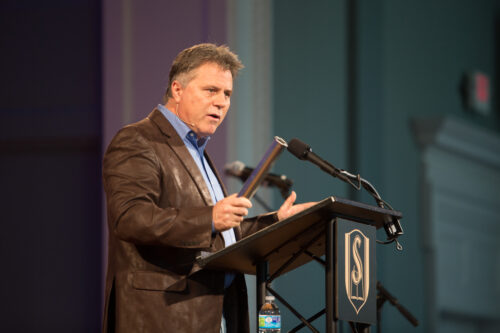 upon to give our lives — to sacrifice everything about us — for the sake of preserving it in our generation and passing it on to people who come behind us.”
In his own life and ministry, Shaddix persevered faithfully towards this end. Called at a young age to pursue the preaching of God’s word, Shaddix set about this work with whole-hearted passion.
In those early years while completing his master’s degree, Shaddix swore two things: “Number one, I would never do doctoral work. Number two, I would never teach. I had absolutely no interest in either one of these things.” His heart was set on preaching the word and preaching the word alone.
And yet, God had different plans for him.
An Emmaus Road Encounter
The same year that Shaddix delivered his “gospel baton” sermon at Southeastern, a young pastor named Landon Dowden co-taught his first DMin seminar as an adjunct faculty member of the seminary.
Dowden, a three-time graduate of New Orleans Baptist Theological Seminary (NOBTS), possessed a deep passion for the work of biblical exposition and spirit-empowered preaching. He inherited this passion from his long-time mentor and teacher: Jim Shaddix.
In fall of 1999, Dowden walked onto the campus at NOBTS where Shaddix then served as both dean of the chapel and professor of preaching. Despite the resolutions of 15 or so years before, God had indeed directed Shaddix’s steps towards both doctoral work and fulltime teaching.
“The first time I met him was in the classroom,” Dowden recalled, “and then when he approached me to be a mentee in his Emmaus Road group, and my life and ministry were forever changed because of that opportunity.”
 One of Shaddix’s close friends had given him a call, advising him to bring Dowden into the Emmaus Road mentorship after hearing the incoming student preach at a camp that summer.
Emmaus Road was a group that Shaddix had started to help young aspiring pastors learn from the preaching of others. Composed of both graduate and doctoral students, the group would meet at the Shaddix house for a homemade meal, courtesy of Debra Shaddix, fondly referred to as Miss Debra. Afterwards they would gather around the television to watch and critique a sermon on a VHS tape.
Shaddix also invited two other young men, Tony Merida and David Platt, to join the group. Dowden, Merida, and Platt — all first-year students — soon became fast friends and would remain so through doctoral studies, pastorates, and the many years to come. However, when they first met Shaddix and joined his mentorship group, they had much to learn.
At one point during that first meeting, Dowden joked to Merida, “I don’t think we belong here,” as a PhD student used his Greek New Testament to critique the preacher’s exposition of the text.
Thinking back on those times with amusement, Dowden said, “We’ll all talk about our pre-Shaddix and post-Shaddix sermons. We had a lot of great illustrations. We had terrible exposition.”
“The first time I heard Dr. Shaddix preach,” he recalled, “it was an Emmaus Road experience for me because my heart burned as he opened the Scriptures, and I could never go back.”
The first time I heard Dr. Shaddix preach, it was an Emmaus Road experience for me because my heart burned as he opened the Scriptures, and I could never go back.
The Role of a Mentor
As a professor, both then and later during his years at Southeastern, Shaddix sought to impress on his students the authority of God’s word and the all-surpassing importance of prayer. As a scholar, he emphasized excellence and walked alongside many doctoral students as their major professor. His passion for discipleship also led him to care for and pour into the next generation of preachers outside of the classroom.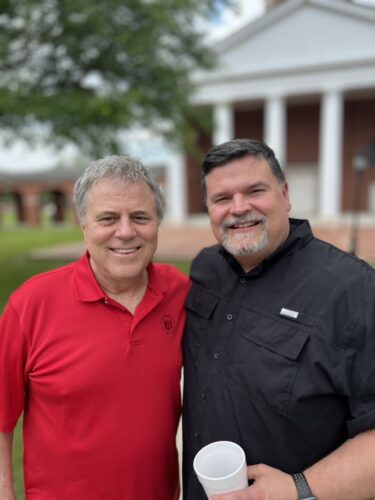
“It was never just about lectures. It was about opening his life and having us in his home to see how he interacted,” Dowden recalled. “He taught us his system for memorizing Scripture and praying Scripture and then praying for his children.”
“He modeled transparency; he modeled consistency; he modeled even what it looked like to pastor locally.”
In many ways, Shaddix modeled the life of Paul — and ultimately Jesus — as he taught and discipled the multitude of young Timothys who came through his classroom. Paramount in his heart was a desire to grow their love for the Lord and for the word of God so that they might handle it with the utmost care — for through the word of God, as Shaddix often reminded them, God’s people are fed.
“There’s one thing I never doubted about Dr. Shaddix,” Dowden said. “He loved Jesus.”
Converging Paths
It was Shaddix’s love for Christ that taught Dowden the importance of approaching God’s word rightly.
“As our heads become full with homiletical knowledge and skill and technique,” Dowden explained, “our hearts should not grow cold. Our hearts should blaze even more as we see Jesus in the text and help other people see Jesus, and that’s an influence from Dr. Shaddix in my own life that I get to carry over with Southeastern, and I’m thankful.”
As our heads become full with homiletical knowledge and skill and technique, our hearts should not grow cold.
When Dowden first came to Southeastern as an adjunct in 2014, he was excited for the opportunity to teach alongside his former professor. During that first week, he and Shaddix taught two separate seminars on campus. Outside of teaching, they shared meals together and stayed in the same guest housing where they watched a national championship football game one evening.
Over the next 10 years, Dowden and Shaddix’s teaching paths continued to cross.
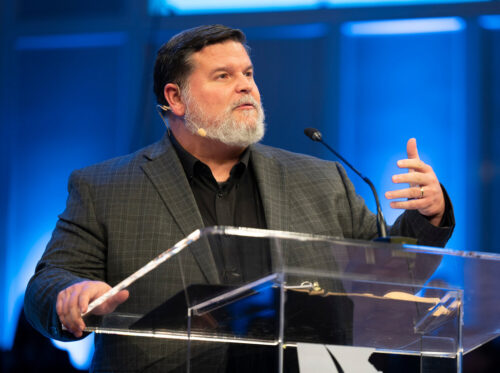 “There was never a time I came to town that we didn’t share a meal and share a hug and conversation,” Dowden reminisced. “The highlight was when he and I taught a PhD seminar together on the theology of preaching.”
Over time, Dowden grew more familiar with the world his mentor had walked in for many years. He began serving as a pastor of a local church in 2005 and, in 2018, transitioned into the role of lead pastor for his current congregation, Hebron Baptist Church.
For both Dowden and Shaddix, preaching to the body of Christ and teaching the next generation are never divorced from each other. The gospel must be both proclaimed and passed on, in the pulpit and the classroom.
“In the end, if you are faithfully preaching the Bible, this is how we measure success,” Dowden explained. “We don’t measure success by movement at an altar after the service. Success is measured by faithfulness to preach the text in the Spirit’s power and point to Christ.”
Success is measured by faithfulness to preach the text in the Spirit’s power and point to Christ.
“The whole Bible points to Jesus in one way or another. He is the hope and the help that we desperately need, and so faithful Christ-centered exposition is, in the power of the Spirit, making much of Jesus wherever we are in the Scriptures.”
Through expository preaching, the gospel of Jesus Christ is proclaimed and the church of Christ is made to look more like her Savior. Through the work of teaching and discipleship, the gospel baton is given from one believer to the next.
The Passing of the Baton
In January of 2025, Jim Shaddix finished his race and went home to be with his Lord and Savior in glory.
In the months leading up to his death, Shaddix battled a severe form of brain cancer that weakened his body but in no way weakened his witness for Christ or his passion for discipleship and the word.
“In my last conversation with Dr. Shaddix, I told him I wanted him to know how much I loved him,” Dowden said. “I wanted him to know how grateful I was for him, and I wanted him to know that, by God’s grace, I wanted to steward well what he had entrusted to me with exposition and with mentoring and with pouring into others as well as I could.”
“Teaching allows an opportunity to pass on what’s been entrusted. It meets a desire the Lord has placed in my heart,” Dowden said, “and it also gives me a chance to hopefully help these students take some good steps and avoid some missteps.”
At Southeastern, Dowden has recently transitioned from the position of adjunct faculty into the role of associate professor of preaching and pastoral ministry. He plans on continuing pastoring in the local church and is excited to also invest more deeply in equipping future pastors and ministry leaders.
As he, in many ways, follows in the footsteps of his own mentor, there are many students still to come who have yet to experience their own Emmaus Road journey or their first expository sermon.
“I don’t want the baton to drop,” Dowden said, recalling a conversation he had with Platt at Shaddix’s funeral. “I want to keep running with it now that it’s in our hands, until we hand it to other brothers and sisters coming behind us.”
I don’t want the baton to drop. I want to keep running with it now that it’s in our hands, until we hand it to other brothers and sisters coming behind us.
When Shaddix gave his 2 Timothy sermon in 2014, he wanted his listeners to know the importance of the gospel and the task set before them and to bring it before God on their knees.
He urged them: “Would you ask God to give you that other worldly power today, to provide a stable target, to run your leg with endurance, and to pass this gospel baton in a steady way to those who come behind you?”
In God’s great kindness and mercy, he granted this request in Shaddix’s own life. Now, the baton continues forward, carried in the hands of countless students, pastors, leaders, and teachers, so that “at the name of Jesus every knee should bow, in heaven and on earth and under the earth, and every tongue confess that Jesus Christ is Lord, to the glory of God the Father” (Phil 2:9-11 ESV).