
Adams Lectures Examine the Charge of the Preacher
Mary Asta Mountain | April 11, 2025

Alistair Begg delivered this year’s annual Adams Lectures at Southeastern Seminary during chapel, April 8 and 10. Begg, long-time pastor of Parkside Church in Chagrin Falls, Ohio, lectured from 2 Timothy 4:1-5 on the pastor’s charge to preach God’s word, particularly addressing young men pursuing pastoral ministry.
He opened his first lecture with a quote from Charles Spurgeon in which Spurgeon compares the gospel to a harried and caged lion who has no need for people to defend it. Instead, what they must do is open the cage and let the lion out so that he might defend himself.
This, Begg said, is Paul’s instruction to Timothy: simply, “Preach the word” (v. 2 ESV). The charge is both a solemn and a simple one, he explained, and requires that the preacher believe the word that he is preaching.
“Timothy needs to understand that what he believes about the Scriptures will become apparent in his preaching,” Begg said, “and what you and I believe about the Scriptures will also become apparent in ours.”
“He needs to be reminded,” Begg continued, “that the Scriptures are divinely inspired, that they are completely reliable, that they are totally sufficient. And the exercise of the ministry of the word is the key to the effectiveness and usefulness of the servant of the word.”
The exercise of the ministry of the word is the key to the effectiveness and usefulness of the servant of the word.
Begg went on to explain the solemness of the charge Paul gives to Timothy, a charge heightened in urgency by Paul’s impending death.
For pastors, preaching the word coincides with caring for the souls of God’s people. Their work is a solemn privilege.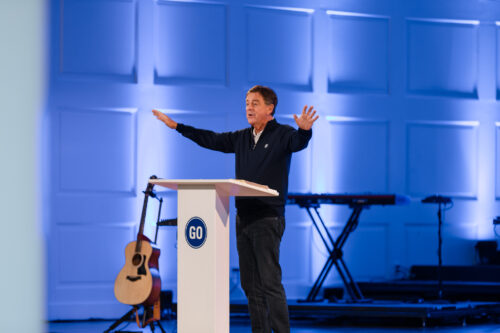
As such, it is vital for the pastor to remember “that our responsibility is actually for our people, under God,” Begg explained, “and that this is of pressing importance.”
In addition to being a solemn charge, one with eternal significance, Paul’s exhortation to Timothy is also a simple and straightforward charge.
Pastors are ministers of God’s word, and their ministry “is to be exercised in the awareness of the fact that the word of God does the work of God by the Spirit of God in the people of God.”
This is something, Begg said, that Timothy needs to be completely convinced of. By extension, it is of equal importance to the many Timothys of today.
“The people are not here to hear our words,” Begg implored his listeners. “The people are here to hear God’s word.”
Begg specifically addressed future pastors in the room: “Ask yourself this question: Am I convinced that the regular, expository teaching of the Bible is the driving force that shapes authentic church life? That’s the question. And the way that you answer that question will determine not only the direction of your ministry, but also the content of your ministry.”
Ask yourself this question: Am I convinced that the regular, expository teaching of the Bible is the driving force that shapes authentic church life?
In the same way that congregants listen to the preaching of God’s word to hear from God, so too should the pastor open his ears to the words he is preaching. Begg warned his listeners of the dangers of growing hardened to the word of God in their ministry.
“It is distinctly possible to ride superficially over the text of Scripture in a way that might be quite remarkable for its erudition and its framework and whatever else — 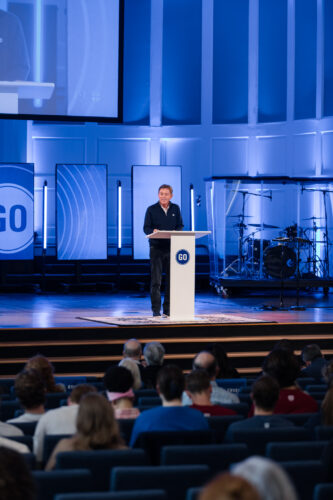 and for there to be an almost palpable sense of the absence of a heart-stirring reality,” he said.
No matter the season, their charge to preach the word is the same.
“When people are hostile or receptive,” he explained, “there’s no excuse for fearfulness, certainly not for laziness. When people are apparently tuned in or tuned out, when the prospect of Sunday coming is delightful or seems dreadful, when the crowds are growing or the crowds are dwindling, it’s so vital — isn’t it? — that we are experiencing the power of the truth that we deliver — in our own souls.”
Continuing through the text, Begg warned his listeners that people throughout time have sought lies instead of truth. Paul expected Timothy to experience that in his own ministry, which is why he gave Timothy four imperatives, telling him what to do: “Always be sober-minded, endure suffering, do the work of an evangelist, fulfill your ministry” (v. 5).
In telling Timothy to remain sober-minded, Begg explained, Paul is reminding him that “it is crucial that you are alert, that you are vigilant, and that you’re enduring to the end.”
Suffering for the gospel will come, and as Timothy continues preaching the word, he will also continue the work of evangelism, which is preaching the gospel.
Finally, as the last imperative, Timothy is to fulfill his ministry.
In other words, Begg explained, “Finish the job. Discharge all the duties of your ministry. Carry out to the full the commission God gave you, and make sure you do it as best enabled by the Spirit of God, with joy and usefulness and encouragement to those around us because the job is not done yet.”
Each year, the Adams Lectures honor the ministry of Theodore F. Adams, who taught at Southeastern for more than 10 years. The Adams Lectures host distinguished theologians on Southeastern’s campus during the spring semester to deliver two lectures on a subject of interest and value to the Christian community.