
Equipped for the Kingdom: Revitalizing the Local Church
Mary Asta Mountain | April 08, 2025
“For me, honestly, it’s harder to stay than it is to go,” said Hannah Rooks, a Southeastern alumna in church revitalization. This realization on her part has led her to ask, then, “How do you stay well?”
 When Hannah stepped onto Southeastern Seminary’s campus for her first semester of classes, the path before her felt foreign and yet familiar. She had spent the past two years investing and growing in her love for the local church in South Georgia. Before that, she had spent two years overseas as a Journeyman in Warsaw, Poland.
Now a brand-new student at Southeastern, on a campus she had never visited before, Hannah found herself pursuing a degree she knew very little about. In fact, she explained, she hadn’t seriously considered the work of church revitalization until she needed to mark a degree on her seminary application form.
“The official definition of church revitalization is taking a church that has plateaued or is declining and helping improve it towards growth,” Hannah explained, thinking back on her seemingly spur-of-the-moment decision. “Well, I’ve always been a problem solver and a fixer,” she thought. It felt as if God was prompting her, saying, “I’ve given you these skills; are you going to use them for my glory?” And so, church revitalization it was.
Looking back at that moment and her previous experience, Hannah has since realized that her decision wasn’t random. God’s hand sovereignly guided her to that moment and beyond. Over the next two and a half years at Southeastern, he would challenge, encourage, and equip her for the next crucial leg of her journey: ministry in the context of the local church.
A Growing Burden for the Local Church
“Community was strongly impressed on me by my time overseas,” Hannah said, thinking about how eagerly she poured into the local church upon her return home.
“Each time I have moved, I have learned how important community is and how important it is to who we are as Christians. But we, in our isolated, Americanized worlds, think it’s okay to live without community, and that’s just wrong.”
While overseas, Hannah had the opportunity to disciple a young woman who had been praying for a mentor. The memory of that experience stayed with her, and once Hannah found herself back in Georgia, God gave her another opportunity to disciple a fellow-church member by simply walking through the book of Mark together.
“Seeing her understand the Bible and connect the dots — it was just so sweet,” Hannah expressed.
At that point in time, Hannah didn’t feel God calling her back to the mission field. Instead, he began to clarify something she had felt for many years.
“I have had a burden for the local church, but for the longest time I couldn’t articulate it — I’d never thought to articulate it.”
I have had a burden for the local church, but for the longest time I couldn’t articulate it — I’d never thought to articulate it.
Growing up, Hannah had attended the same church all the way through college. Her love for her congregation there, for the men and women who walked alongside her since childhood, was mingled with a deep sadness as she watched the church rotate through pastors and slowly decline.
“I remember feeling so burdened, experiencing the loss of knowing that my church was in a state of decline and knowing that a lot of churches in the south are no longer growing churches,” she recalled. “For many, church has lost its center, which is Christ. It’s become a building, no longer the people.”
Hannah carried this burden with her as she entered seminary, but she didn’t know exactly how God would use it.
Foundations Laid
That first semester at Southeastern, Hannah took Theology I, Old Testament I, and Old Testament II. It felt like drinking from a fire hydrant, she described, but in God’s providence, what she learned in one class framed and informed what she learned in another. Jokingly, she said it felt like her professors were intentionally coordinating what they would teach in each class. What she learned in those early semesters began to lay the foundations for later work.
She remembered Steven McKinion, professor of theology and patristic studies, comparing common Christian conceptions with the actual teachings of Scripture. His 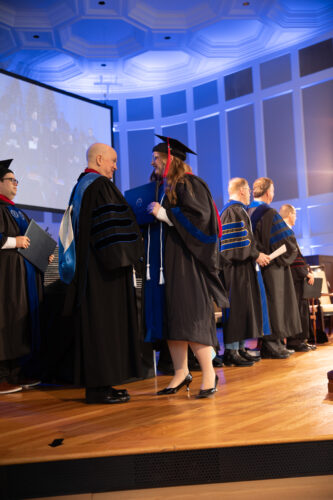 teaching was both convicting and illuminating, pointing out areas of her own theology that needed to be strengthened and helping her better understand the need in the local church.
In those same classes, Hannah also began to find community.
“I don’t know how you can come here and not experience rich community,” she said.
Hannah recalled taking Old Testament with Tracy Mackenzie, professor of Hebrew and Old Testament. “There were a lot of girls in that class. We started a group chat so we could do homework together and meet up to study. A lot of us are still friends, and all because we were simply in the same class together.”
Hannah deeply appreciated engaging in person and learning alongside her peers. “You don’t realize how much you’re going to be formed from other people’s questions and having sidebar conversations,” she said, remembering the times she spent talking with classmates outside of class, discussing theology and Scripture and the many things they were learning.
In addition to her core classes, Hannah began taking her major courses, preparing her for the capstone of the degree: a year long internship in a local church.
“There were so many different books that we read on church revitalization,” she recalled. Much of what she read dealt with practical questions about church growth, resolving actual problems, and applying her learning in real situations.
The classes also gave her the opportunity to practice practical tasks such as creating demographic reports or interviewing church members. Some of the classes she took while completing the internship, enabling her to apply her education immediately in the context of ministry.
“Sometimes the Going is Here”
Hannah pursued her internship with a local body of believers called Cedar Rock First Baptist Church. Like her old church growing up, Cedar Rock was a very small community, and one of the first things she realized about that community was that they loved people well.
“A few months into the internship,” she said, “I realized, ‘I’m falling in love with all of these people.’”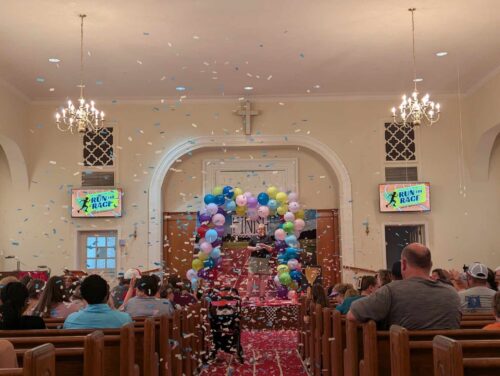
In the context of serving this new church family, Hannah began to see and experience church revitalization firsthand. She had come at a sweet time in the life of the church; because of God’s faithfulness and the faithfulness of its pastor and members, years of labor were beginning to produce fruit.
“I remember during prayer how all of the people were so thankful for crying babies because their church had been so silent for a long time,” she said.
“We’re welcoming people from the community, and we have seen such sweet growth. And I’m not talking about numbers. I’m talking about people understanding that the church is outside of the doors and understanding what it means to be a church. And not just a church that comes and meets and has good fellowship, but one that loves people within and without.”
Personally, the internship taught Hannah the importance of slowing down as she took questions she had learned in class and applied them in a real life setting with people whom she loved. She learned to ask, “Are we changing for the sake of change, or are we changing because it needs to happen?” and “What are we doing as a church that’s pivoting us out, and what are we just doing because that’s what we’ve always done?”
Pivoting outward is a mindset that has stayed with Hannah since God first put missions on her heart. Now, as she serves in the local church alongside believers who love those in their community, that mindset has developed further.
“Part of the Great Commission,” she explained, “is to go where we are. So that’s what we’re doing.” Over the past several years, Hannah has learned that “as we’re called to go, sometimes the going is here.”
Part of the Great Commission is to go where we are. So that’s what we’re doing. As we’re called to go, sometimes the going is here.
“This internship really allowed me to apply all of things I had been learning; everything sort of clicked together, and it allowed me to see on the ground some of the things my professors were talking about,” Hannah said. “I don’t think you should be able to get a degree in church revitalization without working in a church, because you have to put feet to the ground, you have to be hands-on. The church is not theoretical; the church is tactile.”
Ministry Belongs to Every Christian
For Hannah specifically, church revitalization looks much different than it does for many of her classmates.
“A lot of revitalizers are pastors in a pulpit. I will never be a pastor, but there is richness in having somebody else work from the sideline where they are able to assist.”
In her role, Hannah has seen the need for volunteers and church members to serve faithfully alongside their pastors — especially in smaller churches where many  pastors shoulder the heaviest load and work bivocationally.
“I am positioning our church towards growth,” Hannah explained, “even if that’s just sitting down with one person and reading the Bible with them — which is not a ‘just.’ It’s a fabulous thing.”
“I might be a lay member for the rest of my life, serving my church. I came into seminary knowing I might work a regular job for the rest of my life, but this degree is helping me be a better volunteer,” Hannah said. “I may never get paid for serving in the church. And for me, that’s okay.”
Through her time at Southeastern and her service in the local church, Hannah has grown in her belief that the work of ministry belongs to every Christian and is best done in community. Through that ministry, God’s people are reached, his gospel proclaimed, and his glory made known.
Join us in praying for Hannah as she considers next steps after graduation and seeks to be obedient wherever God calls her. Pray that God would continue to impress on her a burden and love for the lost. Pray for the work that she and many others are doing through church revitalization as they seek to build up the local church and make Christ known.