
Equipped for the Kingdom: Writing at the Juncture of Theology and Culture
Mary Asta Mountain | April 23, 2025
“I’ve had a passion for writing ever since I was a kid,” said Southeastern alumnus Trevin Wax. “It started with creative writing and stories and then ideas….”
This love of writing has remained with Trevin over the years, and now it is informed by another passion God has grown in his heart: the intersection of theology and culture. And the end goal of all of this? Missions.
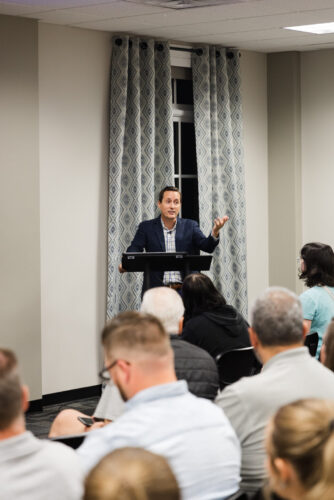 When Trevin first came to Southeastern Seminary to enroll in its PhD program, the work of missions motivated both his studies and his choice of institution.
“I thought Southeastern’s faculty was the leading edge of thinking through issues missiologically in North America at the time, and so I wanted to study with some of those scholars,” he recalled. The missional heart of the seminary resonated deeply with his own.
In the early 2000s Trevin spent several years in Romania pursuing his bachelor’s in pastoral theology. It was during this time that God began to merge his love of theology and the truth with a passion for understanding and engaging culture.
“Part of cross-cultural mission work is that it opens your eyes to all sorts of cultural things you might not have seen before,” Trevin explained. “Living outside of my own American context for several years and being fully immersed in a different way of thinking — of viewing the world and doing ministry — that was really formative for me.”
“My experience in Romania shaped my interest in the intersection of theology and culture more generally,” he expressed. “And then, over the next few years, that sharpened into questions of application: How do I live on mission in my context if I’m back in North America for a season? How do I need to be thinking missiologically, applying some of that missionary mindset in the States that I got on the field?”
In God’s kindness, he made a way for all these passions and interests to not only coexist but also reinforce each other. Trevin’s PhD at Southeastern grew him as a reader, researcher, and writer, giving him the necessary tools to confidently approach the interconnected conversations of missiology, theology, and culture.
Learning How to Learn
At the beginning of his PhD program, Trevin had a conversation with J.D. Greear, visiting professor of evangelism and missions at Southeastern. In that conversation, Greear told him:
“Trevin, the thing about the PhD program is it’s not just about what you study and write in the program. It’s that from this point on, you will know how to study and write differently; it’s about leveling up in your ability to do research, to know how to get in and out of books, to learn what you need to know, to be able to think and research at a different level than before.”
It’s not just about what you study and write in the program. It’s that from this point on, you will know how to study and write differently
Greear’s words couldn’t have been more true.
In 2012, Trevin began taking his first PhD classes; his program was offered in a hybrid format, each class operating as an in-person, week-long intensive. Trevin remembered the many times he traveled to campus for back-to-back seminars, sometimes nine days at a time, completely immersing himself in academic thought and community.
Looking back at that season, he has fond memories of his cohort experience which had a lasting impact on him.
“You not only got to know your professors that you had face time with — you also got to know the students that you were with on this journey together,” Trevin said. “And that was one of the most beautiful aspects, the ability to get to know other pastors and leaders in ministry, some of whom I count as dear friends even today.”
Community was important not only for the camaraderie it offered but also because it acted as a catalyst for learning in the classroom.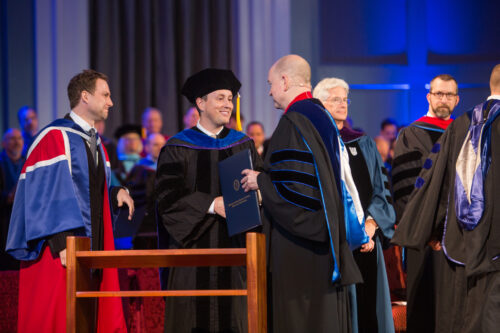
“I remember some of the presentations we had that were great in getting us thinking, discussing, and debating at so many different levels,” Trevin said. “That’s what stands out to me: amazing discussions around terrific books and then applying them to church ministry today and to missional thinking.”
The Ministry of Writing
While Trevin was taking his classes, he was also writing — not just academically, but personally.
Earlier in his journey, he had discovered an outlet for his creative and intellectual pursuits in the form of blogging. It became a discipline for Trevin, giving him the motivation to build the habit of writing regularly.
Blogging allowed Trevin to challenge himself, to determine, “I’m going to write a couple articles a week, and I’m going to train myself to write this way.”
The blog grew in popularity, and Trevin began to see how readers benefited from his posts on theology and culture in particular. In 2012, he had the opportunity to move the blog onto The Gospel Coalition website and to become a regular columnist for them.
“My main calling is writing,” Trevin explained. “Most of my ministry flows from writing and that’s been the case for a long time. Even the other areas where I have influence and leadership, they’re all connected back to the writing, which is connected to the thinking and the reading that must go into the writing.”
Even the other areas where I have influence and leadership, they’re all connected back to the writing, which is connected to the thinking and the reading that must go into the writing.
Communication and critical thinking are essential in any area of ministry, but for Trevin, these skills became the locus of his ministry. That is why he was committed to acquiring an education that would provide him with such life-long skills.
“I always knew when I finished my master’s that I was going to do a PhD, not because I necessarily wanted to teach for the rest of my life, but because I knew I wanted to be stretched. I wanted my ability to do research and writing to be at a higher level,” he explained.
“It’s intense. What you’re doing is laying a good foundation for learning for the rest of your life. For me, it was never about the degree or the credential. I wanted to learn: How do I maximize the use of my mind and set myself up for a lifetime of reading and learning and growing in my understanding of God’s Word, God’s world, theology, and its intersection with culture?”
Gripped by Gospel Reality
Three years after beginning the PhD program at Southeastern, Trevin successfully defended his dissertation — a study on eschatological discipleship — and graduated in December of 2015.
“As I look back at my time at Southeastern and where I grew,” he reflected, “it’s not just in what I learned, but it’s in setting myself up to learn for the rest of my life.”
As I look back at my time at Southeastern and where I grew, it’s not just in what I learned, but it’s in setting myself up to learn for the rest of my life.
Since then, Trevin’s work has taken on a variety of different forms, ranging from teaching at the university level to serving as a teaching pastor as well as serving in different roles at Lifeway Christian Resources — and throughout it all, of course, writing.
Over the years, he has published numerous books on theology and culture and continues to write regularly for The Gospel Coalition. Currently, Trevin works for the North American Mission Board (NAMB) as the vice president for resources and marketing. He has a podcast with NAMB called “Reconstructing Faith,” where he  seeks to bring resources from Church history and the Church around the world into this cultural moment. He and his team support multiple ministries within NAMB, including Send Network, Send Relief, church planting, and more.
“We help support these ministries by getting their stories out,” Trevin explained, “telling the stories of our missionaries that are doing great work, and also by creating resources that help equip pastors.”
As Trevin’s writing acts as the connecting thread between each of his roles, God’s love for his people and for the nations motivates the work that Trevin does. It is through experiencing and understanding God’s love at a deeper level that Trevin’s love for God — and for others — grows.
“It’s why we do missions,” he said. “It’s out of love for the God who calls us, who sends us; love for the world he has called us to, that we’re to steward and then preach the gospel to; love for the lost, for each other as we’re sharpened and as we grow; and love for the gospel, this message that continues to resonate with us and change us, that the Spirit uses to change us over time. All of that — it’s all rooted in the love of God.”
During his PhD work, Trevin gained a deeper understanding of this love and how God’s desire to seek and to save the lost is ultimately at the core of all missiological work.
“That was very shaping for me,” Trevin remembered. “I was studying with a cohort of colleagues and under professors who were gripped by that reality, and so that was something that formed and gripped my heart as well.”
I was studying with a cohort of colleagues and under professors who were gripped by that reality, and so that was something that formed and gripped my heart as well.
From the beginning, communication and writing have played a pivotal role in sharing the truth of this reality. The story of God’s mission to save a people for himself is preserved in writing in the Scriptures, the inerrant, authoritative word of God. Each Christian is tasked with the responsibility of understanding and defending his or her own faith; moreover, believers have been given a great commission to communicate this faith, the good news of the gospel, to a watching world.
It is a responsibility that Trevin and his fellow Southeastern alumni do not take lightly, and it is one that all believers should bear faithfully until the nations are reached and the glory of the coming King is revealed.
Join us in praying for Trevin, his family, and the work that he is currently doing. Pray that he would have wisdom in his writing and teaching, that his love for God would continue to grow and motivate all that he does, and that God would use his gifts for the glory of Christ.