Beyond the Book with Dr. Quarles: “New Testament Textual Criticism for the 21st Century”
Mary Asta Mountain | July 09, 2025

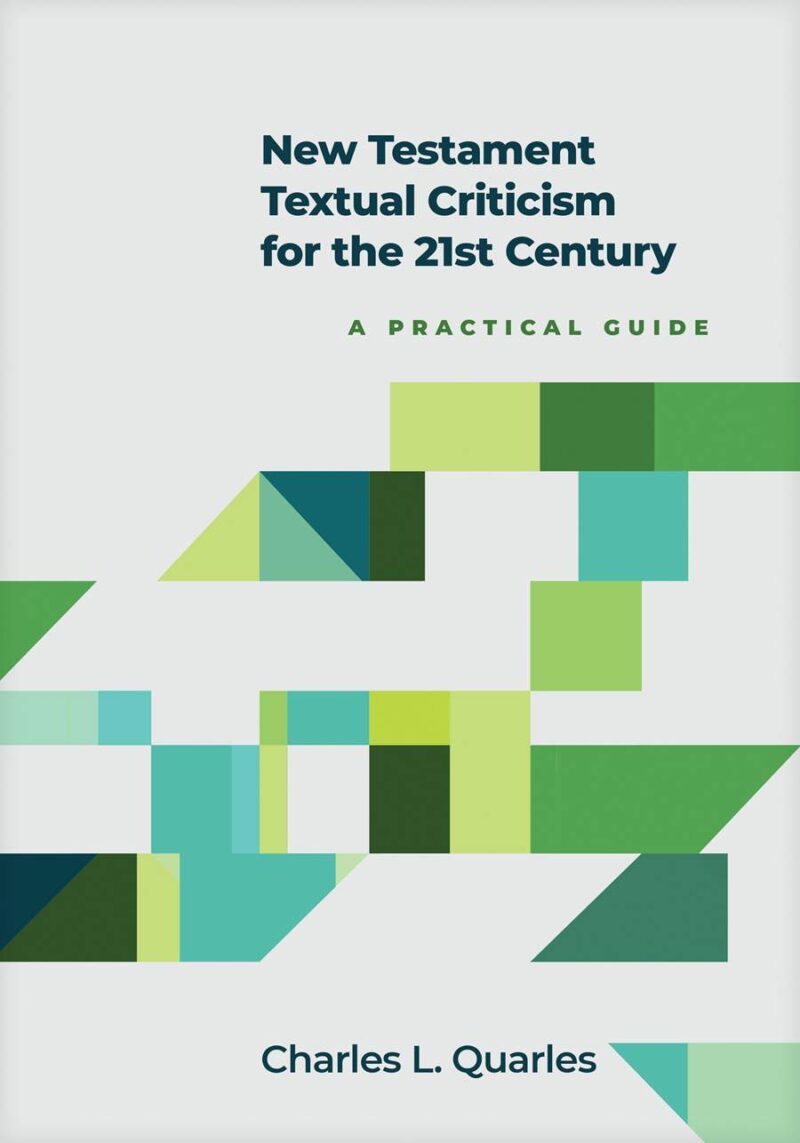
As the discipline of textual criticism continues to develop and improve, so do its methodologies and practices. This encouraging progression naturally necessitates further instruction — an updated guide to the field of textual criticism, one that walks students through these new advancements and equips them to expertly handle the original text with care and precision. Written by Research Professor of New Testament and Biblical Theology Chuck Quarles, the recently published “New Testament Textual Criticism for the 21st Century” does just that.
In addition to teaching at Southeastern, Quarles also serves as the Charles Page Chair of Biblical Theology, director of the Caskey Center for Biblical Text and Translation, and senior research fellow for New Testament. In the following Q&A he takes some time to answer some questions and delve into the contributions of “New Testament Textual Criticism for the 21st Century.”
What motivated you to write this book?
Several respected introductions to New Testament textual criticism have guided New Testament students in the exercise of restoring the New Testament text for generations. These volumes are generally considered to be “tried and true,” and professors and students may be reluctant to replace them or even supplement them with the latest book on the topic. I sympathize with that sentiment. These trusted volumes have shaped my own approach to the discipline in important ways and I am grateful for them.
However, as I taught master’s courses and PhD seminars in New Testament textual criticism over the last decade, I became increasingly convinced that a new introduction was badly needed. The standard introductions masterfully explain the methods and approaches to textual criticism applied in most of the 20th century. Yet, these leave readers unaware of some of the sweeping changes that occurred in the field in the late 20th and early 21st century.
Who is the audience, and how do you hope they will use this text?
The primary audience is the graduate-level New Testament student who has had at least two semesters of Greek. The purpose of the book is to guide students in making good decisions about the original reading of the Greek New Testament in those cases in which our ancient manuscripts differ. Too few people are currently engaged in this important work. I hope that serious readers of this book will step forward, roll up their sleeves, and make their own contributions in this important area of research.
I hope that serious readers of this book will step forward, roll up their sleeves, and make their own contributions in this important area of research.
What are some of the elements of this book that make it a 21st century introduction to New Testament textual criticism?
“New Testament Textual Criticism for the 21st Century” is intended to bring New Testament students and professors who are not specialists in the field of textual criticism (at least, not yet) up-to-date so they can take advantage of new helpful tools in their text critical research. The introduction highlights resources such as the Editio Critica Maior, the Center for the Study of New Testament Manuscripts, the International Greek New Testament Project, the Center for New Testament Textual Studies, the digital resources of major libraries, and sites devoted to specific text-critical issues like the MARK16 virtual research environment.
The book especially features the impressive tools developed by the Institute for New Testament Textual Research such as the Kurzgefasste Liste Online, the NT Virtual Manuscript Room, the Amsterdam Database of Conjectural Emendations, and the online ECM texts with their corresponding databases. It also illustrates how these tools assist in making textual decisions. For example, rather than relying on the old Aland categories (I and II) to identify texts that are generally accurate and reliable (which was not the original purpose of those categories), the book demonstrates how researchers can now compare witnesses to the “initial text,” the restored text printed as the base text in the ECM volumes and new editions of the UBS and NA Greek texts. This is far better than assuming that a text is reliable and accurate simply because the author of a textbook claimed so.
When seeking to find if texts from the same era that are not closely related to each other share a specific reading (which may indicate the reading existed several generations of copies earlier), researchers can find the precise level of agreement between these witnesses using tools produced for the Coherence-Based Genealogical Method (CBGM). This assessment of relationships is far more accurate than simply relying on old theories about text types. The clear step-by-step instructions for using the tools developed by the CBGM do not appear in other introductions.
What are some of the consequences of practicing textual criticism with outdated methods?
Unfortunately, some of the outdated methods are faulty methods and they may result in reaching wrong conclusions about the readings of the original Greek text of the New Testament. Those of us who affirm the plenary verbal inspiration of the Holy Scripture recognize that every word of the original text is authoritative and important. Thus, properly restoring the reading of the original text really matters!
Those of us who affirm the plenary verbal inspiration of the Holy Scripture recognize that every word of the original text is authoritative and important. Thus, properly restoring the reading of the original text really matters!
Per the description, this book helps readers “move from abstract discussion to concrete examples.” As a professor of New Testament Greek, how have you seen this practice of moving from the abstract to the concrete benefit your students in the classroom?
The old adage that a picture is worth a thousand words is true. In my experience, if students are to learn textual criticism, they need more than lectures about the history and various theories of the discipline. They need practical examples showing the relevance of textual criticism and modeling the proper practice of textual criticism. And they need to apply the principles themselves in one exercise after another. We best learn textual criticism by doing textual criticism under the guidance of an experienced mentor who can point out missteps, misunderstandings, and ways to improve.
How does this book help readers to better serve the church and fulfill the Great Commission?
An accurate translation of the New Testament is critical for the ministries of the church and for the Great Commission task of making disciples and teaching them to obey all that Christ commanded. The best translations of the New Testament will naturally be those based on editions of the Greek text that most faithfully and accurately follow the original wording. Restoring the wording of the original Greek text has long been recognized as a “sacred quest” deserving of our greatest effort.
How has writing this book shaped you spiritually?
Writing any book, especially a difficult one, deepens our dependence on God. But this book is more a byproduct of my spiritual shaping than a source of it.
"New Testament Textual Criticism for the 21st Century"
A guide to New Testament textual criticism that introduces students to the methods currently used by the most respected specialists in the field.
While there are many introductions to twentieth-century New Testament textual criticism, scholars and students need a twenty-first-century introduction to the praxis of New Testament textual criticism that refines and replaces some elements of the traditional approach in keeping with recent advancements in the discipline. Methodologies known to be deficient are still being taught, and even New Testament commentators apply outdated and problematic methods in their evaluation of textual variants. This new introduction guides readers in the practice of a more refined, reasoned eclecticism to identify the original reading of the New Testament text. Readers will learn to identify variant readings and the witnesses in support of them from the apparatuses in the major editions of the Greek New Testament.
“New Testament Textual Criticism for the 21st Century” includes several examples and exercises that guide students in applying critical-thinking skills to specific variant units. The goal throughout is to move from abstract discussion to concrete examples to offer students the “picture worth a thousand words.” Most importantly, the book demonstrates how new tools and findings generally discussed only in scholarly literature are changing the text of the most respected editions of the Greek New Testament and can aid researchers in their study of manuscripts.
March 4, 2025
Hardcover, 200 pages