
Partners in the Gospel: Called to Return Home
Mary Asta Mountain | July 30, 2025

“Have you thought about coming back?”
It was a question that Scott Wilson, Jason Mole, and Aaron Still had each wrestled with at some point in the past 15 years.
Ever since finishing their degrees at Southeastern Seminary, “going” was the primary objective for these three friends: going to a church in need, going out of state,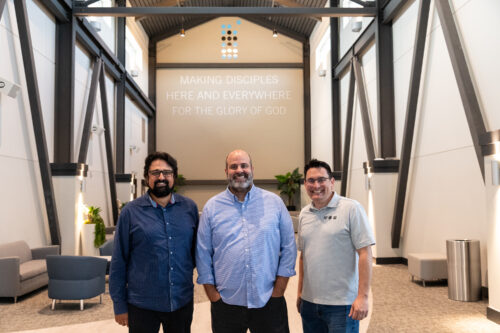 maybe even going overseas. But going back home, to the place and the church where all three of them had grown up? Could that perhaps be God’s call?
“At Southeastern, there is this constant beat of the drum to go — and to go to the hard places,” explained Aaron. “For us, coming back to Melbourne was really tough, because in our hearts we wanted to go to the nations, and we wanted to go to the hard places. And now we find ourselves back at a place that’s familiar.”
But “familiar” isn’t always bad. In fact, as these three friends realized, sometimes it is a strategic pathway to gospel connections, faithful community, and an enduring impact.
“Coming back to Melbourne didn’t feel like resignation or like settling,” Aaron said. “It felt like opportunity.”
“Now we get to be the ones that beat that drum for our people. That’s really what we’re trying to do in Melbourne: disciple, encourage, and raise people up to send them out.”
That’s really what we’re trying to do in Melbourne: disciple, encourage, and raise people up to send them out.
It was during their time at Southeastern that Scott, Jason, and Aaron grew in their passion for discipleship and disciple making. But this was also something that had been powerfully demonstrated in their own lives, as young boys growing up together at First Baptist Church Melbourne.
Raised Up and Sent Out
In 1995, Melbourne hired its new youth pastor, a man named Doug Mauldin. He had his hands full as he began to bring the church’s middle and high school students under his wing, a group that included Scott, Jason, and Aaron.
 Scott and Jason, both in their early high school years, had been close friends since they were 10 years old, around the time when Jason and his family first became members at Melbourne. Scott had grown up there since he was a baby.
Aaron, meanwhile, a few years younger than Scott and Jason, had recently moved to the church with his family and was just transitioning into middle school.
Over the coming years, Doug sought out and invested in each one of them. It was simply how he did ministry. His intentionality, patience, and care for the church’s young men and women would grow to bear fruit for decades to come. And though he didn’t know it at the time, he was raising up future leaders for their own church body.
“I remember the pivotal moment when I was a sophomore,” recalled Aaron, “and Doug asked me to participate in a leadership camp, and I realized, ‘I guess he thinks I’m a leader; otherwise, why am I going on this thing?’ It blindsided me, and then it made me realize, ‘Well, if he thinks I’m a leader, then I need to act like a leader.’”
When Aaron was called into ministry after high school, Doug walked alongside him through the decision and even encouraged him to pursue seminary.
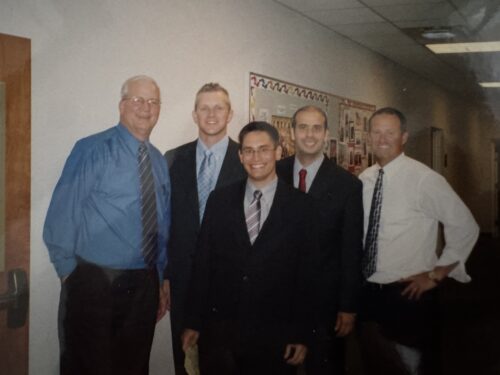 For Scott, the call towards ministry became apparent earlier in his journey — in fact, not long after Doug stepped into his role as youth pastor.
“I remember, when I was still in the youth group — when I was 16 or 17,” Scott said, “Doug would have me take a Wednesday night and teach the Bible lesson for that evening.”
It was valuable exposure and experience that helped Scott eventually confirm his calling to serve in vocational ministry.
Jason, the oldest of the three, experienced God’s call to ministry towards the end of his time in college when, during a worship night with college ministry, he felt God telling him, “I care about people, and that’s what you need to care about too.”
With this new conviction, Jason returned home that summer and began serving as an interim student pastor at a church that Doug connected him to. Not long after, Jason decided to turn his attention towards pursing theological education at Southeastern Seminary, eager to be equipped for full-time ministry.
The People You Meet
Neither Jason, Scott, or Aaron went to seminary with the intention of returning to Melbourne to serve on the staff. At the time, they were simply being faithful to God’s call on their lives.
Scott arrived at Southeastern first, followed shortly by Jason, and in 2008, Aaron transferred in from New Orleans Baptist Theological Seminary, arriving just in time to join Scott as he finished his doctoral degree.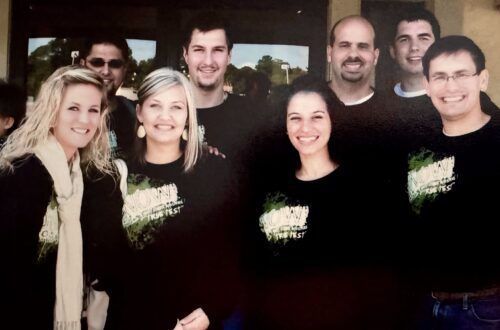
For Scott, community played a large role in his time at Southeastern, and he fondly remembered the evenings when he and his roommate would tramp through the woods near McDowell to get to Jason’s apartment — where, already married, Jason and his wife, Leslie, supplied the hungry bachelors with meals.
“It’s just a brief time,” Scott reminisced. “It feels like forever when you’re doing the courses and the papers, but you look back later, and it was really just a brief part of your life. But such a neat part of your life! You are surrounded by some of the godliest people you’re ever going to meet, who — a few years later — are literally all over the world telling people about the Lord, serving in church and in all different ways. And they were your neighbors all around you during that time.”
“I think,” he said, “that’s probably one of the biggest impacts that seminary has on you: the people that you meet who are studying alongside you while you’re there.”
Lessons Learned
During their time at Southeastern, Scott, Jason, and Aaron didn’t just make friends. They also learned what it means to live as friends and fellow believers, especially 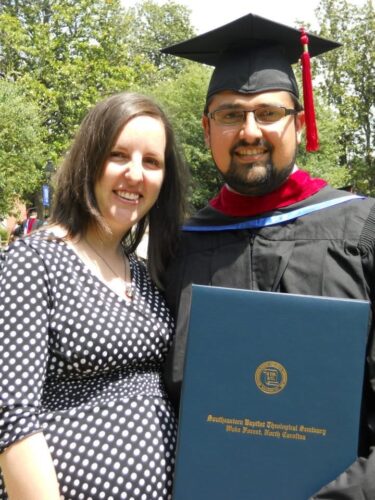 in the context of ministry.
“I remember I took a class on Molinism with Dr. Keathley,” Aaron said, “and he kept bringing in people who disagreed with him to talk to the class. And I was like, ‘What are you doing?’ But he did it, and they would have a conversation, and then they’d walk away friends, and I realized, ‘Oh, so that’s a reasonable way to do that.’”
These and other examples of charitability and friendly disagreement remained with Aaron, Scott, and Jason for years to come, helping them understand what it looks like to serve on a church staff, or with believers who hold differing opinions. Through these examples, God was preparing them, teaching them how to challenge each other and have hard conversations with grace.
Their time at Southeastern also taught them how to ask the right questions.
Creating a Framework and Building Foundations
“I’ve never thought that the purpose of theological education is to answer every possible theological or ministry question you could ever have,” said Scott. “You’re going to face things that are new and that are novel that you didn’t have a class in. I always tell people, ‘Seminary gives you the questions to ask, and it gives you the theological categories to think in.’”
I always tell people, ‘Seminary gives you the questions to ask, and it gives you the theological categories to think in.’
Looking back on his own experience in seminary, Jason was thankful for the way his professors, and Southeastern as a whole, also emphasized having the correct approach to ministry — specifically, having the right heart. For Jason, chapel played an instrumental role in reminding him of the truth of God’s word and spiritually refreshing him throughout the week.
During his time at Southeastern, he learned, “Our hearts need to be right and growing with the Lord now, because, once you get into ministry and all the other pressures that come along with it, it’s tough to develop what hasn’t already been developing.”
One lesson in particular — the importance of personal time with Lord — has stuck with him even into ministry today, reminding him, “I just need to keep it simple and stay in the word and keep developing my heart for the Lord.”
Furthermore, as Scott, Jason, and Aaron sought to grow in their relationship with God, their professors sought to impress on their hearts the reason for theological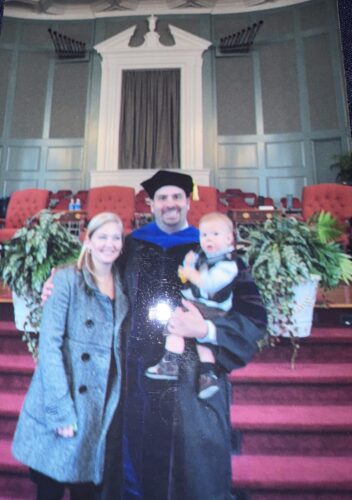 education.
A Ministry-Minded Approach
“I had four classes with Dr. McKinion,” Aaron remembered, “and his approach to theology and theological interpretation of Scripture was really foundational. He was always trying to integrate these things into the church. It wasn’t just knowledge for knowledge’s sake; and that went across the board for all my professors.”
“I remember even, with Dr. Moseley in Hebrew and Dr. Kellum in Greek,” he said, “we were trying to figure out, ‘How do you connect this to your preaching, or how do you connect this to the person sitting in the pews who will never go to seminary?’”
Scott echoed Jason and Aaron’s testimonies with stories of his own professors:
“I had Dr. Hammett for a PhD seminar, and he was a missionary for a while,” Scott explained. “He was a pastor, and he’s a professor and an author.”
Scott found that, while discussions often delved into deep and difficult topics, Dr. Hammett’s experience and love for the church continually framed what he was teaching within the context of ministry.
It was this ministry-minded approach to education that prepared Scott, Jason, and Aaron for their time after Southeastern.
“I didn’t go to seminary just to gain knowledge,” Aaron explained. “I went to serve the church, and I went to make disciples, and I went to encourage others to do the same.”
I didn’t go to seminary just to gain knowledge. I went to serve the church, and I went to make disciples, and I went to encourage others to do the same.
Through discipleship and faithful leadership, their church back home had prepared and encouraged them to pursue the path of ministry long before they thought of going to Southeastern; and it was their years at Southeastern that equipped them to then go out and serve wherever God called them.
Called Back Home
Today, Doug Mauldin still serves on the staff at Melbourne, though now in the position of mobilization and legacy pastor. Only a few weeks ago he celebrated his 30th anniversary of serving on Melbourne’s staff.
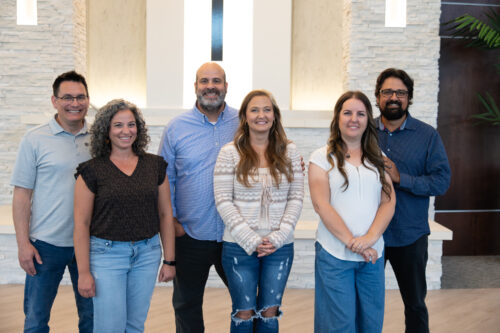 Following 25 years of faithful ministry, former lead pastor Larry Bazer retired and began serving as a member of the church, traveling on missions and training pastors.
Now, Scott serves as Melbourne’s lead pastor after following God’s call back home in 2009, as he was finishing up his PhD at Southeastern. He has been serving in his current role since 2011.
Eight years after Scott returned, Jason felt God calling him back to serve at Melbourne as well, and in 2017 he stepped into the role of next gen pastor.
Only a year later, at Scott’s prompting, Aaron returned as well to serve as Melbourne’s church planting pastor. Part of his role includes helping start a new initiative called Launch 10x, from which the church seeks to plant 10 churches, send out 100 missionaries, train 1,000 leaders, and make 10,000 disciples — by God’s grace, all within 10 years.
“Our mission statement as a church is, ‘Making disciples here and everywhere for the glory of God,’” said Scott. “And so we’re trying to make sure that everything we do is about making disciples, from every small group to every ministry — reaching the lost and discipling the saved. We’re trying to stay laser-focused on that, and I think Southeastern is laser-focused on that.”
We’re trying to make sure that everything we do is about making disciples, from every small group to every ministry — reaching the lost and discipling the saved.
“Southeastern is such a missional place — and that’s part of what we love about it,” Scott explained. “I think that comes from Dr. Akin; it’s the heartbeat of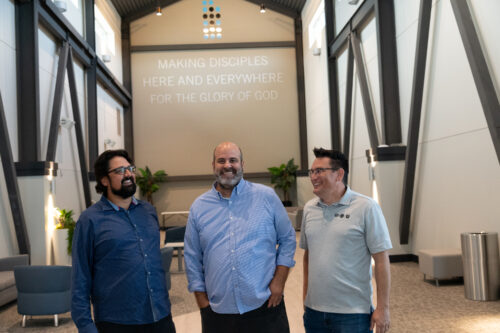 the seminary. And we pray that it’s the heartbeat of our church.”
Scott, Jason, and Aaron didn’t expect to return to their home church to serve in leadership. And yet, in God’s kindness, he has granted them the opportunity to serve in a place that means so much to them, to pour back into the lives of those who raised and discipled them. In God’s providence, he placed them in a ministry context where familiarity gives them opportunities that they wouldn’t otherwise have.
Aaron phrased it as such: “God has brought me to this area and has brought me up in this area for a reason. And so I’m going to minister here in a way that other people who don’t know the area spend years trying to figure out.”
God has brought me to this area and has brought me up in this area for a reason.
Furthermore, as friends and fellow Southeastern alum, Jason, Scott, and Aaron are able to serve their church side by side with an even greater degree of trust and understanding, knowing who they were trained under.
“I don’t think any of the three of us would say we remember every lecture we ever had at Southeastern,” said Scott. “But nonetheless, hearing our professors think 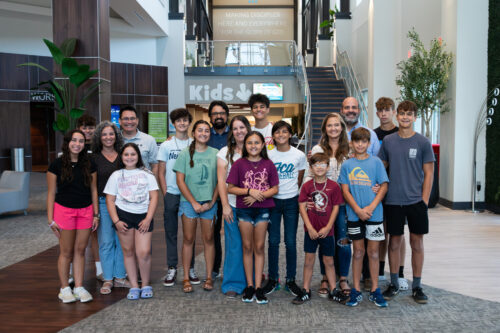 through theological issues and make decisions — and even when they disagreed, hearing why they disagreed, and how they were going back to the word to form their answers — that still shapes us as we’re discussing things in our weekly elders’ meeting and making decisions for the church,” Scott said.
While Melbourne has grown and changed over the years, Scott, Jason, and Aaron are able to attest to God faithfulness in the lives of his people. They have seen this faithfulness throughout their years within the church body and through the testimonies of their family members — many of whom came to faith at Melbourne or have been part of that body for decades.
“This is the church that shared the gospel with us, the church where we got saved, where we got baptized, where we were discipled and called into ministry,” reflected Scott. “What a healthy thing that now we get to invest back into this same church and see the Lord doing amazing things and even see our own kids baptized in this same church!”
Join us in praying for the work of Scott, Jason, Aaron, and the rest of Melbourne’s leadership. Pray for continued faithfulness in ministry and that their love for the Lord would continue to grow. Pray that, through the proclamation of the gospel at Melbourne, hearts would be changed and lives would be transformed for the glory of God.