
An Interview with President-Elect Scott Pace
SEBTS Staff | April 23, 2026

On April 21, 2026, the Board of Trustees elected Scott Pace to serve as the president of Southeastern Seminary and Judson College following President Danny Akin’s retirement on July 31. Pace, a two-time alumnus of Southeastern and Akin’s first PhD student as president, has his own Southeastern story and memories. In the following interview and video, he takes some time to share about how God called him to ministry, to Southeastern, and, now, to the role of president.
Tell us your story — how you went from NC State to Southeastern.
I started as an engineering major, and when God got a hold of my life my sophomore year, I decided to change majors. So, I studied accounting, expecting that I was going to work in the business profession. I continued to serve in the local church, and I was active there, teaching small groups.
Did you and your wife, Dana, meet at NC State?
No, I actually met her brother at NC State. I met him freshman year — so I married my college roommate’s sister. Dana and I met and talked a little bit while we were at State, but then it was ultimately after I graduated that God brought us together. I grew up in Wilmington and never moved back home; Raleigh became my home. So I was working as an accountant, and God called me to ministry two months before I was supposed to be married.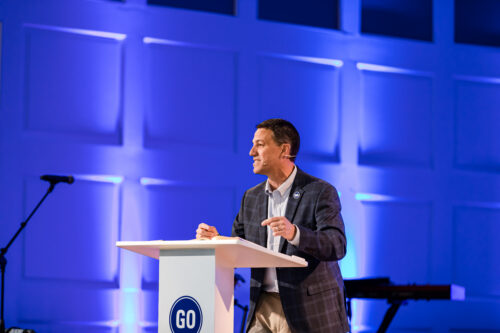
Did you work while you were in seminary?
That’s a funny story. Dana had been to nursing school and was waiting for her licensure to come through, so she had to get a job in the meantime. She started working at an assisted living facility, and about two months into it, she said, “Hey, I think you need to get a job.” And I listened and was like, “Yep, you’re right.” I actually got a part-time job, working at a real estate company answering phones. And then we joined a church plant at the time, Richland Creek, and we were meeting in Wake Forest Middle School. Within six months after we joined, I came on staff as a youth pastor.
At Southeastern you had a class with Dr. Moseley, right? How did that compare to classes at State?
So, my first semester I had Old Testament and Hebrew, both with Dr. Moseley. And it was completely different, having a professor that I knew. I’d connected with him because Dana and I got married my second week of classes. I had to miss week two for our honeymoon, and so he told me, “Don’t worry about studying Hebrew; don’t take your flash cards on your honeymoon.” It was completely different knowing the professor. This material was something I knew mattered and was meaningful, and so I used to soak it up. Just devouring Scripture and having someone walk me through it — it was great. Dr. Moseley was the perfect professor to have my first semester for multiple classes because he blended so well the scholarship of the subject matter with the local church/pastoral/spiritual aspects of the content. That really watered my soul but also filled up my mind with a lot of things I’d never been exposed to.
I tell people all the time, if you can be serving in the church, even in a volunteer capacity, while you’re in seminary, it’s mutually beneficial. Your ministry is informed 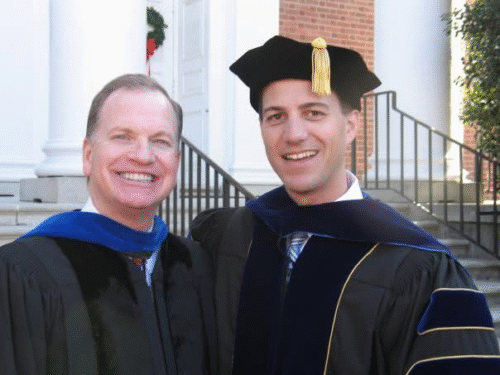 by what you’re learning, but your classroom experience is where you’re filtering and processing through real life in a ministry context, and so both are enhanced.
What about your PhD? How did you end up studying with Dr. Akin?
In the fall of ‘04, Dr. Akin came to present to all PhD students his vision for the PhD program, which was a pastor-theologian model. In other words, it wasn’t academics for the sake of academics — instead, this is how the highest level of academics informs our ministry to the local church. That got me super jazzed. We took a break after he made his pitch, and the director of the program and I were standing at a refreshment table. He said, “Hey, did you hear the good news?” And I was like, “I don’t know. What do you mean?” He said, “You’re going to get to study under the president!” I’d never even met Dr. Akin. He said, “Yeah, he went through the files, and he selected you as one of his students.”
You and a good friend used to meet in Binkley to pray together during your time here. Is that right?
Yes, he’s a pastor in the state now (an AMS), and we would meet right on the front row. We would memorize Scripture and recite it to one another, and we would spend time sharing with one another. We would pray together, pray for what was going on in each other’s lives. We’d pray for our ministries, our future, and everything that was going on.
I had met him in college before God had worked in both of our lives, and then we reconnected when we came here. And we thought, “How is it that we’re both sitting here, where God has worked in our lives to this point to bring us to Southeastern where we could be preparing for ministry?” We found ourselves sitting here, marveling at God’s providence in all those things. That was a sweet time, sweet memory, and it’s hard to come into chapel and not think about it. 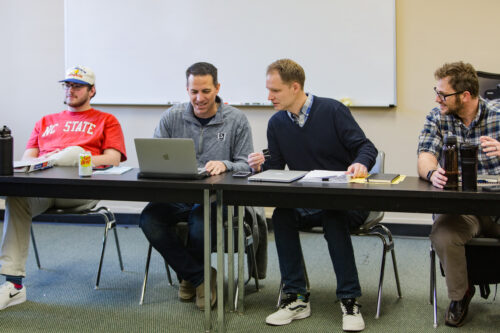
Diet Sun Drop has become your iconic favorite drink. Was that a childhood favorite soda?
It was! Sun Drop is more of a regional drink, locally distributed. Growing up in Wilmington, if you went to Cookie Company at the mall and got a drink, Sun Drop was on the fountain drink. And so we just grew up drinking Sun Drop. When I got older, all of a sudden I couldn’t really drink all the calories I used to, so I thought, “Let’s try the diet Sun Drop.”
Alright, tell us why this parking spot outside of Stealey Hall matters.
When we came here and I started seminary, I took night classes, and my wife, Dana, would meet me. We were newlyweds, and she’d bring me supper on my break or before class so that we could at least eat together before I had to go sit in class for a few hours. When I drive up Stealey Drive, that’s one of the thoughts that comes to mind: I remember parking right there and eating dinner in a car before night class. It’s one of those special moments that you look back on and think, “We were just doing life, but now it’s a memory that’s really special.” It’s part of what campus means to us.
Back in 2019, you were dean of Judson College. Is that right?
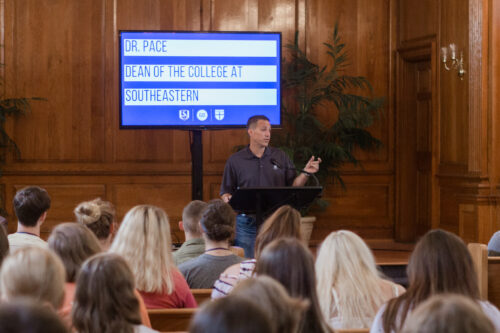 Yes, my time at the university in Oklahoma had prepared me, and Dr. Akin said, “I think you’d be perfect in this role, and so I want to appoint you dean of the college.” I didn’t know what God knew; I think he had that plan in our coming here. It worked out extremely well, and we loved it. We still love Judson College and all the students and getting to be with them.
When you became dean of the college, you brought the class Vocation and Calling with you, right?
Yeah, it was one of those things that’s just an instrumental concept that college students are intrigued by. They want to know what God’s will is for their life and how to pursue that. This understanding of vocation and calling — not vocational ministry necessarily, but vocation as ministry — is important. Questions like, ‘What has God called me to? How can I leverage that for his mission and purpose, and ultimately, how can I fulfill the Great Commission, whether as a schoolteacher or mechanic or a missionary or a pastor?
When we think of calling, it’s a bigger concept than a specific destination. It’s more of this understanding of what God is leading you to do, what he’s equipped, gifted, and even prepared you to do through your life experiences — through where you grew up, how you were raised, your own faith journey, and all of those components. They forge together into this understanding of how God intends you to leverage your life for the Great Commission.
So now: president! Did you ever dream of this?
No, it was never on my radar. I was just trying to be faithful where I was. I never sought out an opportunity or position, but I tell students all the time, “God knows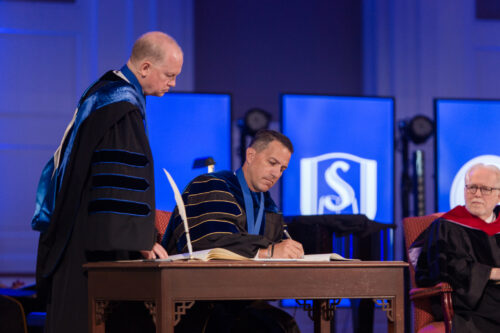 where you are. He knows where you’ve come from. He knows who and how you are, and when it’s time to take you to the next place, he’ll come get you.”
Now, having said that, was there admiration for people who were serving in this role? Of course! Having been able to study under Dr. Akin and get to know him, there was always an appreciation for what he did and how he did it. I learned leadership lessons from him. I would call him for wisdom as we were navigating different seasons of life and ask, “Hey, how should I be processing this? Or how should we think about that?” So, I had an appreciation for him in the role he was in, seeing what he has done with our faculty and staff here, but not in a way that I aspired to it. This is one of these things that feels surreal.
If the Lord tarries and you’re president for 20 years, what do you hope to look back and see?
That we were faithful as an institution to who we are. We’re the Great Commission school, and that’s not going to change. You can’t summarize who we are any better than our mission statement: to glorify the Lord Jesus Christ by equipping students to serve the church and fulfill the Great Commission. When I look back, I want it to be about building on that. Everything that we are now, we will lean into a little harder, a little further. For me, it’s about advancing the global church through the local church. How do we equip pastors to be Great Commission pastors? How do we mobilize congregations and members of congregations to live on mission and to go on mission to get the gospel to the nations? If we can serve and work through the local church, it’ll mobilize to the global church and, ultimately, fulfill the Great Commission.