At the Office with Dr. Aucoin
Mary Asta Mountain | May 27, 2026

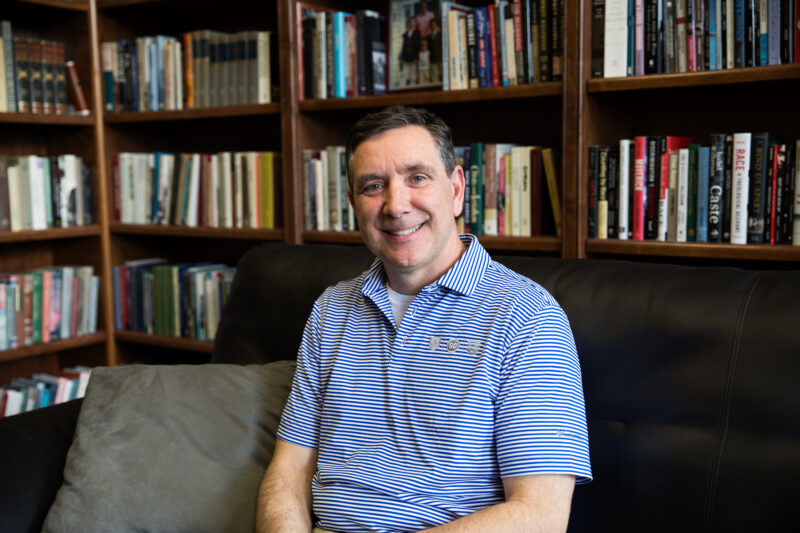
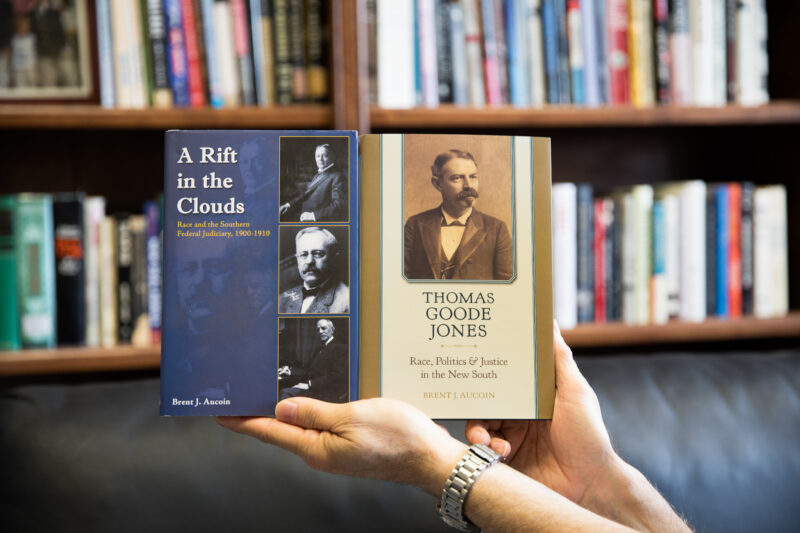
Dr. Brent Aucoin began teaching at Southeastern Seminary and Judson College in 2004 as President Danny Akin’s first faculty hire. Today Aucoin serves as professor of history and associate dean of Judson College for academic affairs. When he isn’t teaching classes on American and Baptist history, he enjoys spending time with his four sons and his wife, fellow Southeastern professor Amanda Aucoin. In the following Q&A, Aucoin shares more about his passion for history, God’s work in his life, and his years at Southeastern.
How did God save you?
I was raised Catholic in New Orleans, stopped practicing for a time during my undergraduate years, and then began attending Catholic church on a regular basis during graduate school. Then, in my first PhD course, I met Amanda Wood — now Amanda Aucoin — and we became friends. I tried to convert her to Catholicism and get her to go to mass with me, but I quickly found that she was very strong in her faith and had been raised in a Baptist home.
At the time I believed in God, and I believed in heaven and hell. But I believed that I could go to heaven because my good works outweighed my bad works. Amanda took me to hear good preaching and connected me with some other graduate students who were doing Bible studies. She also strongly urged me to read the Scriptures, specifically the book of John and then the book of Romans. By the time I got to Romans 7, that’s when I would say I became a Christian. I understood my sinfulness and my need for grace and for the atoning work of Christ. I went from being a believer in God to being born again.
I went from being a believer in God to being born again.
How did you and your wife, Amanda, meet?
We met in what was my first PhD seminar and her first master’s degree seminar. There were probably 15 students in that class, and the professor came in with a big pile of books and said, “Read these, and we’ll meet again a month from today.” All the students looked at one another, and we decided to exchange phone numbers to help one another out. I took advantage of that and went straight to Amanda and said, “So, I should get your phone number so we can consult on this.” She made the mistake of giving me her number, and the rest is history, if you will.
Those first few months of our relationship, we were deep in historical research and reading and then theology. Everything I thought I knew about God and religion and faith was being upended by what I was reading and hearing in Bible studies and my conversations with her. It was an unusual start of a relationship, filled with theological and historical debates. I’m eternally grateful to her. We got married in June of 1995.
When did you first discover your love for history?
Looking back on my life, it’s clear to me I had a love of history very early on. In grade school, I really liked to read historical biographies, and growing up in New Orleans, I especially liked to read about Andrew Jackson. I knew almost everything there was to know about him by the time I was in sixth grade. In my senior year of high school, I became more politically engaged, and that’s why I wanted to pursue journalism. But that very first semester at college, I took a history course that I fell in love with. I also realized I wanted to be able to dig deeper into the various assignments I was given, rather than staying within a journalistic word count. All of that came together and made me switch over to history.
How did your approach to history change after you came to faith?
During my master’s degree, even though I was Catholic, I had a slight level of hostility towards Christianity. I was moving in a liberal direction when it came to American culture and politics. I viewed history as a weapon to be used politically. But after I was converted, at the beginning of my PhD program, my view of history switched to pursuit of the truth, for the sake of the truth — and with the knowledge that all truth is God’s truth. My life changed dramatically in just about every area but certainly in the way I viewed politics and history.
After I was converted, at the beginning of my PhD program, my view of history switched to pursuit of the truth, for the sake of the truth — and with the knowledge that all truth is God’s truth.
What is a foundational piece of Southern Baptist history that you believe does not receive appropriate attention among Christians today?
The first thing that comes to mind is what we call the Conservative Resurgence. In my Baptist history class, I’m astonished on a regular basis by the number of students who, in some cases, know nothing — but more often know just very little about the battle for the Bible among Southern Baptists.
Baptist history is also one of my favorite classes to teach. My students’ response is generally that they were not expecting much from the class and were not big fans of history. But at the end they tell me they’ve found that there’s much more to Baptist history and distinctives than they thought and that it’s much more relevant to their lives and ministry than they anticipated.
How have you seen your history classes shape the minds of your students as they prepare to serve the church and fulfill the Great Commission?
Returning to that Baptist history class, I find that going through the distinctives of being a Baptist is eyeopening for a significant number of students who never learned what it means to be Baptist. During the class, the students learn not only the differences between denominations but also why those differences exist, that those distinctives signify something important. They signify a certain understanding of the Scriptures and a view of what the Scriptures teach. It makes their Baptist identity more meaningful to them when they have a better understanding of who Baptists are and why we believe what we believe. And that part of being Baptist, in our context, is cooperating together to fulfill the Great Commission.
As Dr. Akin’s first hire at Southeastern, how have you seen this institution change over the past 22 years?
When I came here to interview for the job, I was as nervous as could be. But Dr. Akin just talked and talked, trying to sell me on who he was, who Southeastern was, and on his vision for the institution. He was so excited to be here, and he shared all about his plans and his hopes, and then he asked me the hard questions. That was my first interaction with Dr. Akin, and it’s one I greatly appreciate and still think about.
The most noticeable change, since 2004, is that Southeastern has grown and become more effective without losing its pervading spirit. The spirit of the institution was really clear to me when I first stepped on campus: a love for God’s word and a dedication to missions. That has only increased, strengthened, and grown. We’re much more established as an institution than when I first arrived here, but we have the same exact mission and focus and camaraderie that was here 22 years ago.
The spirit of the institution was really clear to me when I first stepped on campus: a love for God’s word and a dedication to missions. That has only increased, strengthened, and grown.
What do you and your family like to do in your free time?
We have four boys in our family, ages 15-25, so we’re very much sports-oriented. We’ve spent a lot of our free time watching them play sports and playing with them. We also love to do hikes as a family — we’ve hiked lots of waterfalls — and we like to take trips and be somewhat active. We like to go to the beach and go skiing, and, really, we like to have people over. We’re members of First Baptist Church of Durham, which is kind of a ways away, so most weekends we find ourselves inviting people over to share a meal with us and do things together.
Your wife, Amanda, also teaches history here at Southeastern. What’s it like getting to work at the same place as her?
I love it. I actually tried hard to make it so that we could work together more. I want to spend every moment I can with her, and it’s great to have her across the hallway. Now that the boys are older, she’s been on campus more often. One of the reasons I wanted her to come to campus so much is that I wanted her to experience what I experienced, being around the other faculty and Dr. Akin and the students. I wanted her to have that as well. It’s been great to go with her to meetings and such, but we also go our separate ways. She has people that she likes to visit with, and I’ll visit others. I’m glad she’s getting to experience more of what I’ve experienced over these 20-plus years.