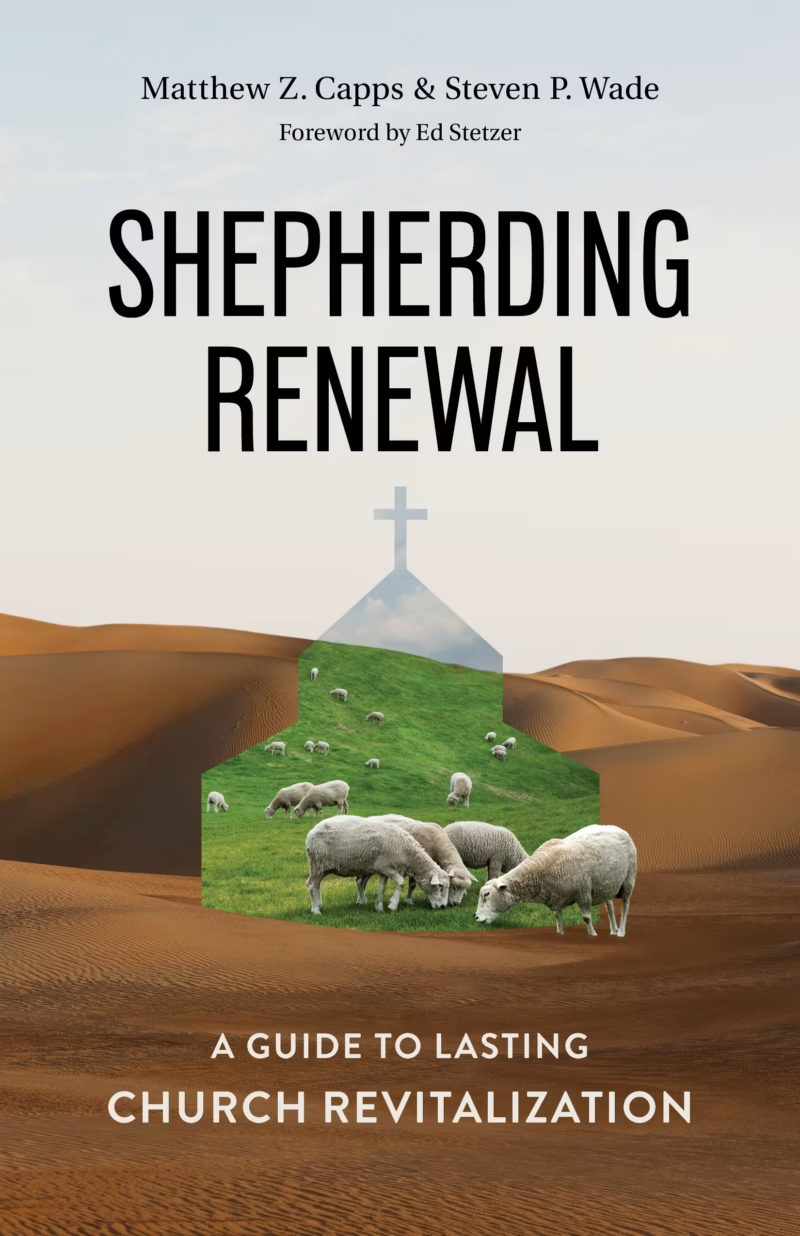
Beyond the Book with Dr. Wade: “Shepherding Renewal”
Mary Asta Mountain | July 07, 2026

On the road towards church health and revitalization, pastors often find themselves in need of an experienced guide. Steven Wade and Matt Capps know this need firsthand through their own experiences leading church revitalizations. In their recent publication, “Shepherding Renewal,” Wade and Capps offer such a guide for church leaders who are beginning the journey of revitalization with their congregations.
At Southeastern Seminary Wade serves as professor of pastoral theology, and in the following Q&A he takes some time to share further about the purpose of “Shepherding Renewal” and the challenges and joys that come with church revitalization.
What inspired the creation of “Shepherding Renewal”?
Matt Capps and I have been friends for over a decade now, and we have both traveled the road of revitalization with churches. Many of our conversations with local church pastors center on the health of their church and how to work toward revitalization. As we discussed these conversations together, the idea of a book to assist pastors and churches on this journey kept coming up. One day we sat down and sketched out the idea of what it looks like to view revitalization as a journey, and the structure of the book just fell into place.
How does this book uniquely contribute to the conversation around church revitalization?
There are some great books on church revitalization that we both recommend to pastors as we help them begin the journey toward health with their congregations. However, many of these publications feel more like a textbook than a field guide. We wrote this book with the idea that pastors and revitalization teams need a field guide to help them on the journey. We tried to fill the book with biblical principles, real-life experiences, and practical solutions.
What are some of the major roadblocks that commonly interfere with church revitalization, and how does this book equip leaders to face them?
A church can unknowingly make choices or fall into patterns that lead to a place of alarming unhealth. Only when a church becomes self-aware and makes the correct diagnosis can they forge a pathway out of decline and develop habits of health. We offer some key questions that help measure health and identify key roadblocks to revitalization in local churches. These include:
- Do debates stall decisions?
- Do the preferences of some stifle the potential of the whole church?
- Have expectations led to pastoral exhaustion?
- Do the membership rolls actually reflect the members of the church?
- Has assimilation been assumed?
What are some of the unseen joys of church revitalization?
While revitalization can be long and exhausting work, the pastor and church that commits to the process gets to see the work of God in the lives of God’s people, the transformation of a community, and the advance of the gospel. Some of the most encouraging joys I’ve experienced are friendships that last for a lifetime. It’s been 27 years since I began as pastor of the first church I was part of that needed revitalization, and today I am still close friends with many of the leaders that were integral parts of that journey. Those lifelong friendships have been precious blessings from the Lord, both in those early days of the journey and now. Some of those folks have even been sent out as part of new revitalization works! I can’t begin to describe the joy in my heart that today I know of at least six other churches that are being impacted by families that have either moved because of life circumstances or been sent with a vocational ministry calling from that core team in our first church. Even as I write that, I pray for them and rejoice in the partnership we shared in the gospel work over 20 years ago!
What advice would you give the pastor approaching this hard and sacred task for the first time?
Pray fervently; study the word faithfully; walk in step with the Holy Spirit; and lean into relationships with those who can encourage, strengthen, and assist you along the way. Once you have this foundation, you can pack for the journey. Chapter 3 offers six initial steps to complete as you begin the journey. First, cast a compelling vision. Casting vision for what can be is vital for motivating people to take the first steps toward revitalization. Next, assemble a revitalization team. The team that will lead the journey will determine the pace of change and success of the journey, so identify and develop this team wisely. Third, understand the specific context of your church. Each church is unique. Revitalization is not a one-size-fits-all endeavor. The journey toward health must be shaped by and for each specific context.
Each church is unique. Revitalization is not a one-size-fits-all endeavor. The journey toward health must be shaped by and for each specific context.
Next, identify the most critical areas that need to be addressed. Assessment is crucial when determining direction. Most churches are experiencing multiple issues that will need to be addressed; prioritizing the order in which to address them will often determine the success of the journey. Fifth, develop a plan. Like any journey, planning is essential. Without a well-developed plan, the journey through the revitalization process can become overwhelming. Finally, commit yourself to practicing patience along the way. Multiple times in the New Testament, leaders are exhorted to exercise patience with God’s flock. Most of the time pastors prepare and plan for change well before the congregation is aware of the steps they are asked to take. Leaders who exercise patience will build trust, and trust is the currency needed to lead change.
For the church members reading this book, how does church revitalization apply to them, and how can they support their leadership and church body in this process?
Revitalization doesn’t happen through leadership alone. The journey is one for the entire congregation. The goal is a healthy church that is growing spiritually and advancing the gospel locally and globally. The success of God’s mission for his church requires the participation of every member of the congregation. Every member has gifts and abilities needed to complete the journey. So, we exhort every member to be involved. Discover your gift. Play your part. Carry your load. Commit to the journey. You are vital to church health!
How has God particularly challenged or encouraged you throughout the process of writing this book?
Writing this book has brought to mind the many ways God has worked through people in the churches I have been privileged to lead over the last two decades. God’s grace to transform me, the leaders of these two churches, and the members who are doing the work of the ministry is a constant source of encouragement and faith. I am encouraged because I know that what has been accomplished has only been completed by the miraculous work of our God. I am strengthened in my faith because I have been able to witness God’s hand transforming lives, growing his church, and advancing his kingdom. To God be the glory.
“Shepherding Renewal”
It is not difficult for the observant Christian to recognize a church in decline. In every small town, suburb, or city, there is often a church on the brink of shutting their doors, or at the very least recognizing the stagnancy of a church’s growth. Matt Capps and Steven Wade know this not only from observation, but from experience in their own revitalized churches. In “Shepherding Renewal,” these pastors address the hardship of serving a church in decline, and even more so address the need to breathe new life into the dying church.
May 12, 2026
Paperback, 208 pages